
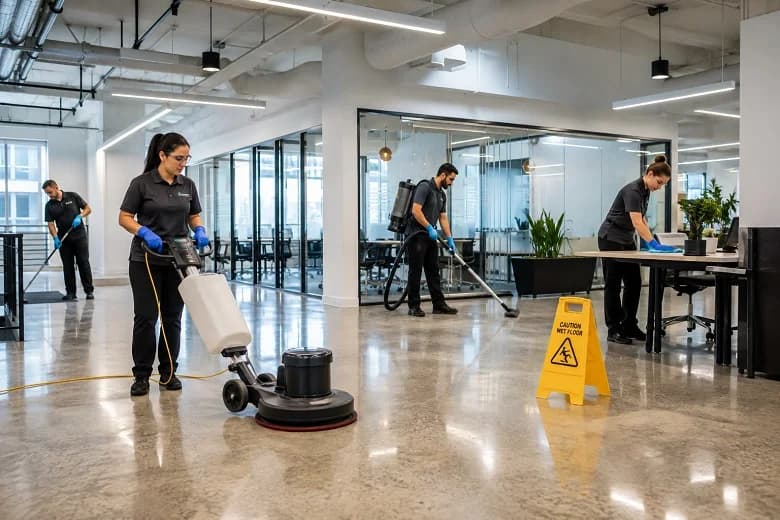
Unlike other fields, cleaning work does not require a dedicated professional license. However, a cleaning company does require business-regulatory licensing when the business employs workers. According to the Law on Employment of Workers by Manpower Contractors and Service Contractors, 1996, every cleaning company employing more than one worker must obtain a service contractor license from the Ministry of Labor. This license is intended to ensure that the employer meets its obligations to employees, including employment conditions, wages, insurance, and social security contributions.
Operating a cleaning company without a service contractor license constitutes a criminal offense; therefore, this is one of the first and most important steps in establishing a company in this field.
Professional Qualifications and Work Regulations
1. A cleaning company frequently uses portable electrical equipment beyond its licensing. These devices include vacuum cleaners, polishing machines, or washing machines. Therefore, companies are subject to several stringent safety regulations. The purpose of these regulations is to ensure professional and safe work. Employees using electrical equipment and additional mechanical equipment must receive basic training in accordance with the Work Safety Regulations (Electricity), 1990. The company management has a duty to ensure that equipment has double insulation or is properly protected, to avoid using damaged equipment, and to ensure that the electrical supply is protected by an appropriate residual current device to prevent electrocution.
2. The use of industrial cleaning chemicals requires knowledge of warning symbols and proper storage methods, in accordance with the Hazardous Substances Law, 1993. Due to the possible use of cleaning chemicals containing chemicals and toxins as defined in the law, the law requires that any use, storage, or possession of toxins comply with safety rules. When dealing with high quantities or concentrations, a toxins permit is also required.
3. Every employer is required to train their employees on general safety matters according to the Work Safety Ordinance [New Version], Section 4 (a) "In a place where a person works under the authority of the occupier or pursuant to an agreement with him in work that would make the place a factory if that person were an employee of the occupier, such person shall be regarded as a factory for the purposes of this Ordinance. (b) "Occupier of the place," for the purposes of this section - including the owner of the place."
It is important to understand that these trainings go beyond regulatory requirements. They all reduce operational risks, especially when working with institutions and large clients.
Professional Insurance Protecting the Business
A cleaning company must maintain appropriate insurance such as:
* Third-party liability insurance - covering property damage or bodily injury that may occur during work
* Employers' liability insurance - protecting employers from employee injury claims if, God forbid, an employee is physically harmed or becomes ill during or as a result of their work.
* Insurance for industrial equipment and cleaning machines.
These insurances typically constitute basic conditions for working with institutions and large clients.
Choosing a Business Structure and Proper Management
The choice of business structure affects the reporting method, operations, and the company's ability to grow. In most cases, a licensed self-employed person is an appropriate structure for a cleaning company starting out. Businesses planning to employ large teams or work with institutions may consider opening a private company (Ltd.)
Proper management includes:
Reporting working hours in accordance with the Hours of Work and Rest Law
Complete documentation of expenses and absolute separation between personal and business accounts.
Summary
A cleaning company succeeds when its management is as precise as the work itself. Professional guidance in the initial stages helps prevent common mistakes and build stable cash flow. The professional guidance that we offer can assist in establishment, dealings with tax authorities, and ensuring financial stability.